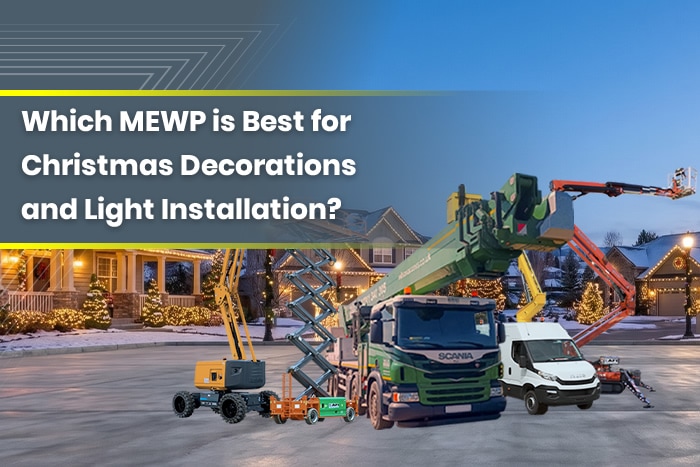
Choosing the best MEWP for Christmas decorations and light installation depends on the working height, required access, ground conditions, and installation location. Push-around lifts and mast lifts suit many indoor decorating tasks, while scissor lifts provide a stable platform for working at height. For outdoor displays, articulated boom lifts, telescopic booms, spider lifts and cherry pickers can help operators reach higher or difficult-to-access areas safely and efficiently. The right machine will make it easier to install festive lights, hang decorations and complete seasonal displays while keeping the work area accessible and organised.
How do I choose the right MEWP for Christmas decorations?
Answer five questions: where is the work, how high, how far across, how tight is the access, and what is the ground like? Indoors, choose compact electric machines. Outdoors, consider booms or spider lifts. Compare working height and outreach, not height alone.
- Start with five questions: where, how high, how far across, how tight is the access, and what is the ground like?
- Platform height is not working height, and height is not reach.
- Indoor work favours electric and compact machines, while outdoor work favours booms and tracked machines.
- Ask AFI to confirm the specification against your survey before you commit.
Table of Contents
- Five Questions That Decide the Machine
- Platform Height, Working Height and Outreach
- MEWP Comparison for Christmas Work
- Example AFI Machine Specifications
- Electric, Diesel and Hybrid Power
- Common Mistakes When Choosing a MEWP
- When One Machine Is Not Enough
- Matching the Machine to the Surface
- One Large Machine or Two Smaller Ones?
- Worked Examples
- Questions to Ask Before You Book
- Final Thoughts
- Get in Touch with AFI Rentals
- Frequently Asked Questions
Explore the Christmas MEWP Guides
These related articles explain how powered access equipment can support different Christmas decoration and lighting projects:
- Using MEWPs for indoor Christmas decorations
- Installing outdoor Christmas lights with cherry pickers
- Commercial Christmas decorations using MEWPs
- Large Christmas tree installation using MEWPs
- Christmas light displays and event decorations with MEWPs
- Cherry picker and MEWP hire costs for Christmas lights
- Safe Christmas decoration installation using MEWPs
- MEWP types for Christmas decorations: where each machine works best
Five Questions That Decide the Machine
Before choosing a MEWP, answer five practical questions about the job.
- Where is the work? Indoor work usually requires electric power and suitable floor protection. Outdoors may allow diesel or hybrid machines and equipment designed for rougher ground.
- How high do you need to go? Work out the height of the highest point you must reach.
- How far across? If you need to reach over an obstacle, outreach matters as much as working height.
- How tight is access? Measure doors, gates, corridors and turning spaces before choosing the machine.
- What is the ground like? Establish whether the surface is firm and level, soft, sloped or uneven.
These answers help narrow down the machine types before you compare individual models.
Platform Height, Working Height and Outreach
Three measurements are often mixed up when comparing access platforms.
- Platform height is how high the floor of the platform rises.
- Working height is the approximate maximum height a person can reach while standing on the platform. It is commonly around two metres higher than platform height.
- Outreach is the horizontal distance from the machine to the work area.
A machine with plenty of working height but limited outreach may not reach a roofline behind a porch. Equally, a boom with long outreach may not be necessary when the work is directly overhead.
“Always ask which height figure a specification quotes. Comparing a working height on one machine with a platform height on another is the easiest way to hire a machine that is too small.”
MEWP Comparison for Christmas Work
| Machine | Strength | Limit | Best Festive Fit |
| Push-around | Moves through doorways, quiet, light | Limited height, no outreach | Homes, small interiors |
| Mast lift | Compact, vertical, tight spaces | Limited platform size | Halls, shops, churches |
| Scissor lift | Large platform, high capacity | Straight up only, needs level ground | Atria, wide ceilings, flat facades |
| Articulating boom | Reaches up and over obstacles | Smaller platform than a scissor | Rooflines, obstructed access |
| Telescopic boom | Long straight outreach | Cannot reach over obstacles as easily | Building fronts, tall trees |
| Spider lift | Tracks, stabilisers, narrow access | Smaller platform, slower to set up | Gardens, restricted sites |
| Van mount | Quick, mobile | Needs a standing position on a road or drive | Streets and town centres |
| Truck mount | Great height and reach | Needs space and a stable position | Tall buildings |
Example AFI Machine Specifications
Machine categories can cover a wide range of sizes. The following examples show the working heights of selected AFI models, taken from the same fleet list as our complete guide to Christmas decorations and lights using MEWPs. They are useful reference points when planning Christmas decoration work, but you must still confirm the correct machine against the site and task. Outreach is not listed here, so ask AFI for the outreach figure of your chosen model.
| Machine Type | AFI Model | Working Height |
| Van Mount | VM13.5 (Versalift VTL-135-F) | 13.50m |
| Spider Lift | TR23L (CMC 23) | 23.00m |
| Spider Lift | TR23L (CMC 23) | 23.00m |
| Truck Mount | TM35B (Bronto S35EM) | 35m |
| Truck Mount | TM37 (Wumag WT370) | 37m |
| Electric push-around lift | Pop Up Pro 10 IQ (PA10E) | 5.00m |
| Electric mast lift | Haulotte Star 10 (BMJ26E) | 10.00m |
| Electric scissor lift | JCPT D0607S (S12E) | 5.60m |
| Electric scissor lift | Skyjack SJ4626 (S26E) | 9.92m |
| Electric scissor lift | Skyjack SJ4632 (S32E) | 11.75m |
| Diesel scissor lift | Skyjack SJ9250 (S50D) | 17.24m |
| Electric articulating boom lift | Skyjack SJ30 ARTE (BA30NES) | 11.00m |
| Articulating boom lift | Skyjack SJ46AJS (BA45DS) | 16.10m |
| Articulating boom lift | JLG 800AJ (BA80DS) | 26.46m |
| Telescopic boom lift | JLG 660SJ (BS66DS) | 22.12m |
| Telescopic boom lift | Genie SX180 (BS180DS) | 56.86m |
These figures are model-specific, not guaranteed specifications for every machine in a category. Outreach can also vary with platform load, boom position and machine configuration. Always check the current manufacturer's specification sheet and confirm availability with AFI Rentals. For specifications on spider lifts, van mounts and truck mounts, see the hire pages or ask the AFI team.
For example, a small electric scissor lift may suit indoor decorations at around 5.6m working height, while a larger electric scissor lift reaches 11.75m. Where the work requires reaching over an obstacle, an articulating boom may be more suitable. For a restricted outdoor site requiring greater height, a spider lift may provide a different access option.
Electric, Diesel and Hybrid Power
Power type affects where a machine can work. Electric machines are quiet and emission-free, and they're usually the best choice indoors. Diesel and hybrid machines can work outdoors over longer periods and on tougher ground. Match the power to the location, and ask about charging if you choose electric.
Common Mistakes When Choosing a MEWP
Choosing the wrong machine can cause delays and create unnecessary costs. Common mistakes include:
- Choosing on working height alone and ignoring outreach.
- Forgetting to check the route to the work area.
- Hiring an outdoor machine that is unsuitable for an indoor floor.
- Underestimating the combined weight of people, tools and decorations on the platform.
- Failing to check the machine's dimensions and weight.
- Booking late and having fewer suitable machines available.
A site survey and a check of the machine's technical specifications can help avoid these problems.
When One Machine Is Not Enough
Some projects need two types of machines. A hotel might use a scissor lift in the lobby, and a boom lift on the exterior, or a large home might need a push-around inside, and a spider lift in the garden. Describe the whole project to AFI so the right combination can be arranged.
“The right machine is rarely the largest. A machine that is too big for the space can be harder to position, harder to use and more of a risk than one that fits the work.”
Matching the Machine to the Surface
| Surface | What To Consider |
| Polished or tiled indoor floor | Electric machine with non-marking tyres and floor protection |
| Concrete yard or car park | Most machines work well, provided the surface is level and strong |
| Tarmac driveway | Check for soft patches in warm weather and use spreader plates if needed |
| Lawn or soft ground | Tracked spider lift or ground protection |
| Gravel or uneven ground | Rough-terrain machine or tracked machine |
| Slope | Check the machine's gradient limits, and do not set up on ground that exceeds them. |
One Large Machine or Two Smaller Ones?
Sometimes the question is not which machine, but how many. One large machine can cover a whole site from a single set-up, while two smaller machines can work side by side, fit through tighter access and keep the job moving if one is delayed.
One larger machine suits jobs where all the work is within reach of one standing position, such as a single tall facade or one big atrium. It means one delivery, one operator and one set-up, but it needs more space, a stronger surface and a clear route to site.
Two smaller machines suit projects with separate areas or tight access, such as a push-around indoors and a spider lift in the garden, or a scissor lift in the lobby and a boom on the exterior. Two crews can work at once, each machine fits its own space, and you only pay for the bigger machine where the work really needs it.
How to decide. Compare the total hire cost, the number of deliveries, the access route for each machine and how long the job takes with one machine or two. Describe the whole project to AFI and ask for both options to be priced.
Worked Examples
A terraced house with a front porch
The job is lighting the roofline and the porch. The porch means outreach matters, and a front driveway or pavement may limit space. An articulating boom lift is the logical choice, or a compact spider lift if the street is too narrow.
A four-storey hotel with a lobby tree
There are two jobs: the lobby tree inside, and the facade outside. An electric scissor lift suits the lobby, and a telescopic boom lift or truck-mounted lift suits the exterior: two machines, one project.
A back garden with side access
The gate is narrow, and the lawn is soft. A tracked spider lift can pass through a narrow gate and spread its weight across the ground, making it the practical choice for tree lighting in this kind of garden.
Questions to Ask Before You Book
Before confirming a hire, ask the supplier:
- What are the working height and horizontal reach of this model?
- What are its width, height and weight, and will it fit through the access route?
- Is it electric, diesel or hybrid, and is that suitable for the site?
- Are its tyres or tracks suitable for the surface?
- What is the platform's safe working load, including people, tools and materials?
- Is operator training or machine familiarisation required?
- Will the machine need stabilisers, spreader plates or ground protection?
Providing accurate site information helps the hire team recommend a machine that suits the work.
Conclusion
The best choice for MEWP hire for Christmas decorations is the machine that fits your working height, outreach, access route and ground conditions, not necessarily the largest on offer.
Use the five questions, compare real model specifications and describe the whole project to your supplier. The right match can save time, reduce unnecessary costs and help manage risks during festive installation work.
AFI's Site SurvAI can also help with the selection process. You can upload an image of your site and the tool will analyse the environment to recommend suitable powered access equipment. It can be a useful starting point, alongside a proper site assessment and confirmation from the hire team.
Want a second opinion on your machine choice? Send the AFI team your working height, outreach, access details and dates, and ask about current hire offers. Contact AFI Rentals or browse all machines..
FAQs
What is the difference between platform height and working height?
Platform height is how high the platform floor rises. Working height normally adds about two metres to allow for the operator's reach, so it is the larger figure. Always check which figure a specification quotes before comparing machines.
Is a scissor lift or a boom lift better for decorating?
A scissor lift suits straight vertical access and provides a roomy platform. A boom lift is more suitable when you need to reach over or around an obstacle. Choose based on the work area, working height, and outreach required.
How does a mast lift compare to a scissor lift?
A mast lift is more compact and suits tighter spaces such as halls, churches, and shop interiors. A scissor lift usually has a larger platform and may carry more people and materials, but needs more room to position and a suitable floor. Choose a mast lift for confined access and a scissor lift when platform space matters.
Are spider lifts worth the extra effort for a house?
They can be useful when access is restricted. If a wheeled machine cannot pass through a narrow gate or reach the work across a suitable soft-ground area, a tracked spider lift may be a practical option. It needs space for setup and stabilisers, so check the access route and ground before hiring.
Can one machine do both indoor and outdoor jobs?
Some machines may suit both environments, but the power type, tyres, dimensions, and weight must match each location. An outdoor machine may be too heavy or unsuitable for a finished indoor floor. For projects with very different areas, two machines may be more practical.
What size of MEWP should I hire?
Choose a machine that meets the required working height and outreach while still fitting the access route. Check its dimensions, weight and platform capacity as well. A larger machine isn't automatically better, so measure the work area and ask the supplier to confirm it's a good match.
Is a bigger machine safer?
No. Safety depends on suitability, setup and operation, not size. A machine that is too large for the space may be difficult to position or unsuitable for the floor or ground. The right machine fits the work and is operated within its limits by a trained, competent person.
Does tyre type matter?
Yes. Non-marking tyres can be suitable for polished, tiled and other finished indoor floors. Outdoor machines may use tyres or tracks designed for rougher surfaces. Tell the supplier what surface the machine will cross and stand on so the correct equipment and any necessary protection can be considered.
Can Site SurvAI help me choose the right MEWP?
AFI's Site SurvAI tool allows you to upload an image of your site. It analyses features such as height, terrain and access points, then recommends suitable powered access machines. Use it as a starting point, then confirm your final selection with AFI Rentals after checking the site requirements.
Where can I find a machine's technical specification?
AFI's machine hire pages provide information about its equipment categories and individual models. You can also ask the AFI team for the current specification sheet. Check working height, outreach, dimensions, weight and lifting capacity before booking.