
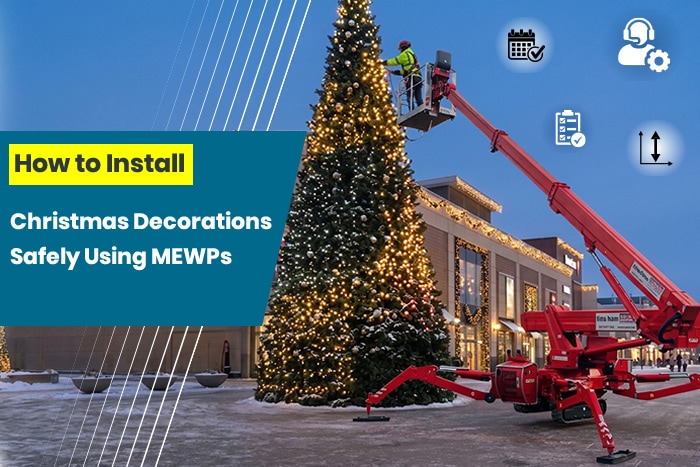
Installing Christmas lights at height requires proper planning, suitable access equipment, and trained operators. Whether decorations are being fitted to a commercial building, retail display or outdoor event, the work must be assessed for risks such as falls, unstable ground, overhead power lines, falling objects and electrical hazards. A suitable Mobile Elevating Work Platform (MEWP), a trained operator and a clear rescue plan help teams complete festive installations while managing these risks.
How do you install Christmas lights safely at height?
Plan the work and complete a suitable risk assessment before starting. Select the right MEWP, ensure operators are trained and familiar with the machine, check ground conditions and weather, establish an exclusion zone, and prepare a site-specific rescue plan. Identify overhead power lines before positioning equipment, and ensure lighting and electrical connections suit the intended environment.
- Plan the work, assess the risks and choose the safest suitable equipment before anyone goes up.
- Operators need training and familiarisation on the specific machine, and a ground person should be ready to lower the platform in an emergency.
- Check the ground, the weather, overhead cables and the area beneath the platform.
- Light fittings and cables need their own electrical safety checks.
Table of Contents
- The Legal Framework in Brief
- Plan Before You Lift
- What Are the Main Hazards When Installing Christmas Lights at Height?
- Operator Training and Familiarisation
- Pre-Use Checks Every Day
- Ground, Weather and Surroundings
- Vehicle-Mounted and Tracked Machines
- Harnesses and Staying on the Platform
- Electrical Safety for Lights and Cables
- Handling Decorations at Height
- When to Stop Work
- Site Briefing and Communication
- Protecting Members of the Public
- Conclusion
- Get in Touch with AFI Rentals
- Frequently Asked Questions
Explore the Christmas MEWP Guides
Explore other articles in our Christmas MEWP guide series for more information on equipment selection, installation methods, project planning, and safe working practices.
- Complete guide to Christmas decorations and lights using MEWPs
- Using MEWPs for indoor Christmas decorations
- Installing outdoor Christmas lights with cherry pickers
- Commercial Christmas decorations using MEWPs
- Large Christmas tree installation using MEWPs
- Christmas light displays and event decorations with MEWPs
- Which MEWP is best for Christmas decorations and light installation
- Cherry picker and MEWP hire costs for Christmas lights
- MEWP types for Christmas decorations: where each machine works best
The Legal Framework in Brief
The Work at Height Regulations 2005 set a simple order of thinking: avoid work at height if you can, prevent falls where you cannot, and reduce the consequences of a fall if one still occurs. A MEWP helps prevent falls by providing a guarded platform. Lifting equipment that carries people is also covered by the Lifting Operations and Lifting Equipment Regulations (LOLER), which require thorough examination at least every six months. BS 8460 is the British Standard code of practice for the safe use of MEWPs.
Plan Before You Lift
A risk assessment identifies the hazards associated with the work and the precautions needed to control them. Before Christmas decorations are installed, consider:
- The height and position of the decorations.
- The type and working limits of the selected MEWP.
- Ground conditions and the machine's access route.
- Weather conditions, including wind and rain.
- Overhead power lines and other obstructions.
- Pedestrians, vehicles and other people nearby.
- The weight of workers, tools and decorations.
- Emergency lowering and rescue arrangements.
A method statement should explain how the work will be carried out, who is responsible for each task and what precautions must be followed. Share the arrangements with operators, supervisors and the ground team before work begins.
What Are the Main Hazards When Installing Christmas Lights at Height?
| Hazard | Control |
| Machine overturn on soft or sloping ground | Check the ground, use ground protection and choose a machine suited to the surface |
| Operator falling from the platform | Keep inside the guardrails, never climb on them and follow the harness guidance for the machine type |
| Contact with overhead cables | Identify cables beforehand, keep well clear and seek advice from the network operator |
| People struck by the machine or falling objects | Use barriers, signs and a ground person to keep the area beneath clear |
| Strong wind or poor weather | Stay within the manufacturer's limits and stop work if conditions worsen |
| Electric shock from lightning | Stay within the safe working load, counting people, tools and decorations |
| Overloading the platform | Stay within the safe working load, counting people, tools and decorations |
| Being unable to get down after a fault | Have a rescue plan and a trained ground person who can use the emergency controls. |
“A rescue plan is not paperwork for the sake of it. If the platform stops working while someone is up, the plan is what gets them down quickly and calmly.”
Operator Training and Familiarisation
Operators should be trained on the type of machine they will use, then shown the controls, limits, and emergency features of that specific model. IPAF categories include 3a for mobile vertical machines such as scissor lifts and 3b for mobile booms. AFI Training delivers accredited courses, and AFI provides familiarisation videos to support machine-specific instruction.
Pre-Use Checks Every Day
- Look for visible damage, leaks, loose parts and tyre or track condition.
- Check guardrails, gates and the platform floor.
- Test controls and the emergency lowering device.
- Confirm the machine has current inspection documentation.
- Check the safe working load plate and the intended use.
Ground, Weather and Surroundings
Look at what is beneath the machine as well as above it. Drains, manholes, cellars and soft verges can fail under weight. Check the weather forecast before work and again on the day. Manufacturers state a maximum wind speed for outdoor use, commonly around 12.5 m/s (28 mph) on many machines, but always follow the figure for your specific model. Keep a clear exclusion zone below the platform, and protect the area against falling objects.
Vehicle-Mounted and Tracked Machines
Van mounts, truck mounts, and spider lifts have their own setup requirements. Vehicle-mounted platforms work from outriggers, so set them on firm, level ground with spreader pads where needed, and use traffic management and a marked work area when working beside a road. For this reason, AFI's van mounts carry Chapter 8 rear chevrons, weigh under 3.5 tonnes, and require an IPAF 1b qualification. At the same time, truck-mount drivers should check the vehicle's licence category.
Spider lifts spread their weight through tracks and stabilisers. Level the machine and extend the stabilisers fully before raising the platform, follow the manufacturer's set-up sequence, and protect delicate floors with boards. Electric and lithium spider lifts are often the best choice for delicate indoor floors, but check ground pressure and load capacity first.
Harnesses and Staying on the Platform
On boom-type machines, operators typically wear a harness with a short lanyard attached to the designated anchor point. On scissor lifts, the guardrails are the primary protection, and harness use depends on the risk assessment and the machine's guidance. In every case, stay inside the guardrails, keep both feet on the floor and do not stand on rails or planks to gain extra height.
“If you cannot reach it from the platform floor, move the machine. Climbing the guardrail to gain a few more centimetres is how most avoidable accidents begin.”
Electrical Safety for Lights and Cables
Festive lighting adds electrical risk. Use lights and cables rated for outdoor use where relevant, keep connections off the ground and out of water, and do not overload sockets or extension leads. Use a residual current device, and replace any damaged light string or cable. Do not run cables where they create trip hazards or where a machine could crush them.
Handling Decorations at Height
Carry only what you need and keep tools secured. Lift heavy items using proper manual handling techniques, and secure any item that could fall. Where materials need to be passed up from the ground, use a controlled method rather than throwing or reaching.
When to Stop Work
- Wind rises towards the machine's limit, or gusts become unpredictable.
- There is ice, heavy rain, poor visibility or a thunderstorm.
- The machine develops a fault or a safety device does not work.
- People enter the exclusion zone and cannot be moved on.
- The ground starts to move or soften.
Site Briefing and Communication
Before work starts, brief everyone on the plan: where the machine will stand, where the exclusion zone is, who the ground person is, what the signals are, and what to do in an emergency. Agree how the operator and ground person will communicate, whether by radio, hand signals or voice. A short briefing at the start of each shift keeps everyone aligned.
Protecting Members of the Public
People who are not part of the job are the hardest to control. Barricade off the area, display warning signs, and do not let anyone walk beneath a raised platform. Where the work is next to a pavement or road, check whether traffic management or a pedestrian diversion is needed, and secure tools and materials so nothing can fall.
Conclusion
Safe Christmas light installation depends on preparation, suitable equipment and trained people. Before work starts, assess the site, select the right MEWP, check ground and weather conditions, identify overhead hazards, and ensure electrical equipment is suitable for the environment.
Operators should understand the machine, while the ground team must know the rescue arrangements and emergency controls. Keep people clear of the working area and stop whenever conditions become unsafe. Applying these principles helps businesses and installation teams manage festive work at height responsibly.
Need help choosing a machine, arranging training or understanding what your site requires? Talk to the AFI team and ask about current hire offers. Contact AFI Rentals, or read more on health and safety at AFI.
FAQs
Do I need to wear a harness in a scissor lift?
Guardrails are generally the primary fall protection on a scissor lift. Whether additional personal fall protection is required depends on the machine manufacturer's instructions, the task and the risk assessment. Always follow the applicable site procedures.
What is a MEWP rescue plan?
A MEWP rescue plan explains how an operator will be brought down safely if the platform cannot be lowered normally or an emergency occurs. It should identify who will respond, how the ground controls will be used and what additional assistance may be required. The plan must be specific to the machine, task and site.
What is a pre-use inspection?
A pre-use inspection is a check carried out before operating the machine to identify visible damage, leaks, tyre or track problems, damaged guardrails, control faults and issues with emergency lowering systems. Report any defect, and do not use unsafe equipment until the issue has been resolved.
What wind speed is too high for a MEWP?
The maximum permitted wind speed depends on the individual machine and its manufacturer. Check the operating manual and machine information plate rather than relying on a general figure. Stop work if wind gusts or changing weather conditions make operation unsafe, even if the stated limit has not been reached.
Can I stand on the guardrails to reach further?
No. Standing on guardrails, boxes, boards or other objects on the platform is dangerous. It can cause a fall or affect the machine's stability. If the work is out of reach, lower the platform and reposition the MEWP safely.
How much weight can I carry on the platform?
Never exceed the safe working load stated by the manufacturer. This includes the combined weight of operators, tools, decorations and other materials. Consider how the load is distributed and follow the machine's instructions for platform capacity.
Who is responsible for safety when I hire a MEWP?
Safety responsibilities are shared between the parties involved in the work. The hire provider must meet its duties to supply suitable, safe equipment and provide relevant information. The employer, hirer or site management team must also plan and supervise the work, select competent operators and ensure the equipment is used safely.
What should I do if a MEWP comes into contact with an overhead power line?
Treat the situation as a serious electrical emergency. If it is safe to remain on the platform, the operator should stay there and warn others to keep away from the machine. Do not approach or touch the machine or anything in contact with the line. Contact the emergency services and the electricity network operator, and follow their instructions. Do not approach or use the equipment again until the network operator confirms it is safe.
Is it safe to work alone on a MEWP?
Working alone at height is not recommended. A nominated ground rescue person should be available, understand the emergency controls and know how to follow the site rescue plan. If the operator becomes incapacitated or the machine stops working, someone on the ground may need to respond.
What training should a ground person have?
A nominated ground rescue person should receive familiarisation with the specific MEWP's ground and emergency lowering controls. They should understand the rescue plan, know how to communicate with the operator and be familiar with the site's emergency arrangements. Practise rescue procedures where appropriate.
What does HSE GS6 say about working near overhead power lines?
HSE GS6 guides planning work near overhead power lines and preventing accidental contact or dangerous close approach. Before using a MEWP near overhead lines, identify the lines, assume they are live unless their owner confirms otherwise, and consult the electricity network operator about safe clearance and control measures. Do not rely on a generic distance without obtaining the required site-specific advice.