
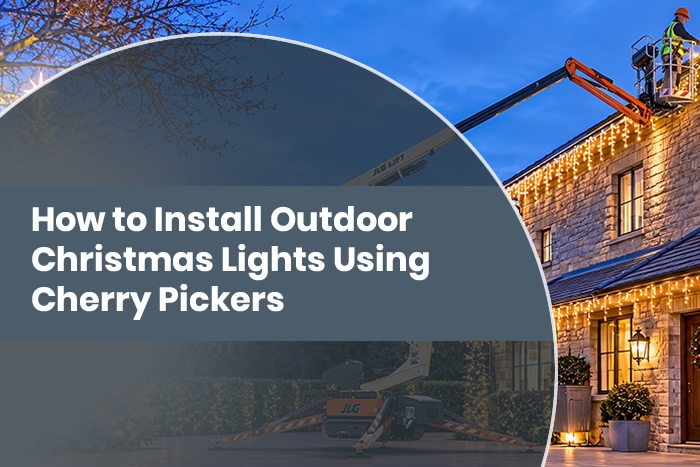
Installing outdoor Christmas lights at height requires the right access equipment, careful planning and safe working conditions. Cherry pickers and boom lifts make it easier to decorate rooflines, gutters, trees, building facades, porches and other hard-to-reach areas. An articulating boom lift can reach over obstacles, a telescopic boom provides extended straight-line access, and a spider lift is useful where garden access or ground conditions are restricted. Choosing the right machine depends on the working height, horizontal outreach, site access and ground surface. With the correct MEWP, trained operators and suitable lighting fixings, outdoor Christmas decorations can be installed more efficiently and safely.
What is the best machine for outdoor Christmas lights?
An articulating boom is usually the best starting point for houses because it reaches over porches and hedges. Telescopic booms suit long, flat frontages, and spider lifts suit gardens with narrow access. Check ground conditions and outreach before choosing. Van mounts and truck mounts add mobility and extra reach for roadside houses, high-street frontages and taller buildings.
- Cherry picker is the everyday name for a boom-type MEWP: articulating, telescopic, van-mounted or truck-mounted.
- Articulating booms reach over obstacles, telescopic booms give straight-line reach, and spider lifts reach awkward gardens.
- Check the ground, the access route and the route of the lights before you choose a machine.
- Use purpose-made fixings for gutters, fascias and tiles, and keep installation and removal in the same plan.
- Van mounts and truck mounts suit roadside and tall-building jobs, and they need a safe, level standing position for their outriggers.
Table of Contents
- What Is a Cherry Picker?
- Which Outdoor Jobs Suit a Cherry Picker?
- Step-by-Step: Installing Outdoor Christmas Lights
- Ground Conditions and Access
- Fixing Lights to Different Surfaces
- Reaching Over Obstacles
- Van Mounts and Truck Mounts for Roadside and Tall Buildings
- Timing the Installation
- Choosing Lights for Outdoor Use
- Protecting Gardens, Driveways and Neighbours
- Conclusion
- Get in Touch with AFI Rentals
- Frequently Asked Questions
Explore the Christmas MEWP Guides
Explore these related guides for more information about choosing equipment, planning installations and working safely at height:
- Complete guide to Christmas decorations and lights using MEWPs
- Using MEWPs for indoor Christmas decorations
- Commercial Christmas decorations using MEWPs
- Large Christmas tree installation using MEWPs
- Christmas light displays and event decorations with MEWPs
- Which MEWP is best for Christmas decorations and light installation
- Cherry picker and MEWP hire costs for Christmas lights
- Safe Christmas decoration installation using MEWPs
- MEWP types for Christmas decorations: where each machine works best
What Is a Cherry Picker?
A cherry picker is a platform mounted at the end of a boom, letting operators reach up and out rather than only straight up. The term covers articulating booms, telescopic booms, van mounts and truck mounts. Tracked spider lifts work similarly and are particularly good where access is narrow.
Which Outdoor Jobs Suit a Cherry Picker?
Almost any outdoor installation that involves height and reach. The most common festive tasks are lighting rooflines, gutters, and gables; wrapping lights around trees; dressing building facades; and fitting decorations to porches, canopies, and balconies.
| Outdoor task | Machine type | Why it works |
| Roofline, gutters and gables on a house | Articulating boom lift | The jointed boom reaches over porches, conservatories and hedges |
| Long straight shopfront or building front | Telescopic boom lift | Straight outreach along a flat facade |
| Garden trees and rear elevations | Spider lift | Tracked and compact, with stabilisers for uneven ground |
| Street-level jobs and small commercial buildings | Van mount | Quick to set up and mobile |
| Taller buildings and large frontages | Truck mount | Greater working height and reach |
Step-by-Step: Installing Outdoor Christmas Lights
- Survey the site. Note the working height, the distance the platform must reach sideways, and anything that stands between the machine and the work.
- Plan the light route. Decide where lights will run, where the power will connect and where each section starts and ends.
- Select the machine. Choose based on height, outreach, ground and access, not just the biggest model.
- Set up on firm ground. Position the machine according to the manufacturer's instructions, using ground protection or spreader plates if the surface requires it.
- Install from one end. Work steadily along the run, fitting clips first and cable second, so the load is never hanging from a single point.
- Test the lights. Check they work before moving or removing the machine.
- Tidy and record. Note fixing positions and take photographs so removal in January is quicker.
“Lay the lights out and test them on the ground before they go up. Finding a dead section at roof height costs a lot more time than finding it at ground level.”
Ground Conditions and Access
Ground is the first thing to check, because lawns, soft verges, gravel drives and sloping driveways all limit which machine you can use. For a surface-by-surface breakdown, see our guide to the best MEWP for Christmas decorations and light installation. As a rule, tracked spider lifts spread their weight and suit lawns and uneven garden ground, while wheeled boom lifts need firmer, more level surfaces.
Also check how the machine will get there. Gate widths, overhanging branches, parked vehicles and tight corners can all prevent a machine from reaching the work area. When access is a problem, a compact spider lift can often succeed where a wheeled machine cannot.
Fixing Lights to Different Surfaces
- Gutters and fascias: use clips designed for that purpose rather than nails or staples that can damage the surface or the water seal.
- Roof tiles and slates: use tile clips, and avoid walking on roof coverings unless it is safe to do so.
- Trees: wrap lights loosely and avoid tight wire or cable that could restrict growth.
- Masonry and facades: use fixings suited to the material, and check first whether fixing to the structure is permitted.
Reaching Over Obstacles
Outreach is the horizontal distance a platform can reach from the machine's base. A building with a porch, conservatory or garage extension below the roofline may need more outreach than height. An articulating boom can raise the platform and then reach across, which is why it is often the starting choice for homes with awkward frontages.
Remember that quoted working height is not the same as platform height. Working height typically includes about two metres of reach above the platform, so check which figure you are looking at when you compare machines.
“Height gets the headline, but outreach decides whether the machine can actually get to the work. Always measure how far across you need to go, not only how far up.”
Van Mounts and Truck Mounts for Roadside and Tall Buildings
When a house sits on a road, or a building is taller than a boom can comfortably reach, vehicle-mounted platforms come into play. A van mount is a self-drive platform built on a van chassis. It sets up on outriggers, carries tools and materials in the vehicle and moves quickly between locations, which suits roadside houses, shop fronts, lamp posts and signage. AFI notes that its van mounts weigh under 3.5 tonnes and need an IPAF 1b qualification to operate.
A truck mount is a larger vehicle-mounted telescopic or articulating boom. AFI quotes truck mounts with a reach of up to 75m, making them the usual choice for tall commercial buildings, long frontages, and town-centre displays, and they drive straight to site. Both van mounts and truck mounts need a firm, level standing position for the outriggers, and roadside work often needs traffic management. For ordinary houses, an articulating boom or spider lift is usually enough.
Timing the Installation
Shorter days and changeable weather make outdoor work in autumn and winter harder to schedule. Book early enough for the installation to happen in good conditions, and leave spare days for delays. If the machine stays on site between installation and testing, plan where it is parked and how it will be kept secure.
Choosing Lights for Outdoor Use
Outdoor lights face rain, frost and wind, so buy products labelled for outdoor use. Check the ingress protection (IP) rating on the packaging; IP44 or higher is the usual minimum for outdoor festive lighting. Check each string's length against the distance it must cover, and plan where the plug-in points and any timers or light sensors will sit before the machine goes up.
Protecting Gardens, Driveways and Neighbours
A MEWP is heavy and may need space around it. Lay protection over lawns, block paving and decorative surfaces before the machine arrives, and keep the work area clear of garden furniture, plant pots and vehicles. Let neighbours know when the work will take place, particularly if the machine or delivery vehicle will affect parking or shared access.
Conclusion
Outdoor Christmas lights look best when you plan the installation from the ground up: test the lights, check the surface, choose a machine with the outreach you need, and fit them with the right clips. Do that, and a cherry picker makes the job faster and far safer than a ladder.
Get in Touch with AFI Rentals
Need help choosing between an articulating boom, a telescopic boom and a spider lift for your lights? Tell the AFI team about your site and ask about current hire offers. Contact AFI Rentals or see all machines for hire.
FAQs
Can a cherry picker be used on a lawn?
Sometimes. Wheeled machines can cause ruts on soft ground, so a tracked spider lift or ground protection is often a better choice. Describe the lawn when you enquire.
How do I fit lights to gutters or fascias without damaging them?
Use clips made for the surface rather than nails or staples, and fit them at regular intervals so the weight is shared. Avoid anything that pierces the gutter or its seals.
How far sideways can a cherry picker reach?
That depends on the model. Outreach is listed alongside height in the specification, and boom machines are chosen largely because they can reach out as well as up.
Can a cherry picker reach over a conservatory or porch?
An articulating boom is designed for this because its jointed boom can lift the platform above an obstacle, then extend across it. Measure the distance across the obstacle to confirm the outreach you need.
How much space does a cherry picker need on a driveway?
Compact models fit on many driveways, but you also need space to set up, and some machines require stabilisers or outriggers. Check the machine's footprint and the surface before hire.
Can I light up a tree using a cherry picker?
Yes. A boom lets you work around and above the tree, and a spider lift suits trees in gardens with narrow access. Keep the platform clear of branches that could snag or damage controls.
Are van-mounted or truck-mounted cherry pickers suitable for a house?
It can be, particularly where the house fronts a road or has easy driveway access. Van mounts are mobile and quick to set up, but they need a suitable standing position and enough outreach for the work. A truck mount is rarely needed for an ordinary house, but it comes into its own for tall buildings, long frontages and town-centre streets, where its extra reach and mobility save time.
How long does it take to light the outside of a house?
A typical house can be lit in a day or less when the lights are tested, and the plan is clear. Complex rooflines, large gardens or multiple trees take longer, so base the hire period on the survey.
Can I install outdoor lights in the evening or at night?
Only if the work area has enough lighting to see clearly and the risk assessment covers it. Poor visibility makes judging distance and spotting hazards harder, so daytime is preferred where possible.
What should I do with a cherry picker overnight?
Lower the platform fully, switch off and remove the key, and park it on stable ground away from traffic and pedestrians. Follow the hire company's instructions about security and storage.