
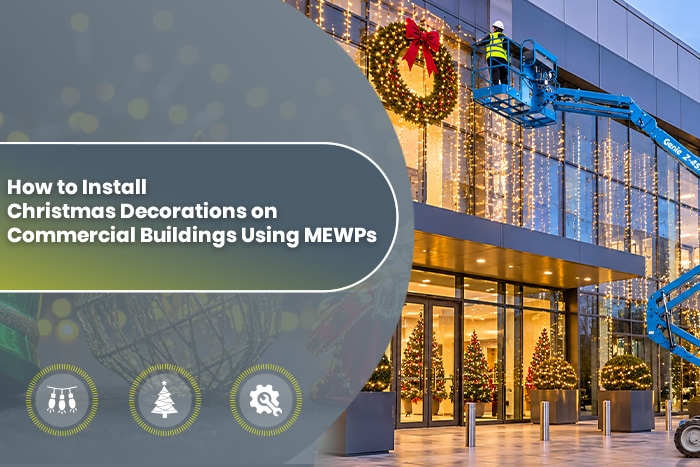
Installing Christmas decorations on commercial buildings requires suitable powered access equipment, careful scheduling and proper site planning. Scissor lifts and mast lifts are commonly used for indoor areas such as reception spaces and shopping centre atriums, while articulating booms, telescopic booms and vehicle-mounted platforms help reach exterior facades, entrances and rooflines. The right MEWP depends on the building layout, working height, ground conditions and access requirements. Installations should also account for trading hours, pedestrian safety, approved fixing points, and removing decorations after the festive season.
How are commercial Christmas decorations installed?
Most commercial installations use scissor lifts or mast lifts indoors, and boom lifts, van mounts or truck mounts on frontages, usually outside trading hours. Get landlord consent and agree on fixing points, pedestrian controls and risk assessments before the machine arrives.
- Commercial projects bring scale, fixed deadlines, trading hours and public footfall, so planning matters more than machine size.
- Choose access equipment by building type: scissor lifts and mast lifts for interiors, booms and truck mounts for frontages.
- Get landlord, facilities and insurer agreement before anything is fixed to the building.
- Out-of-hours working and weekend hire help installations finish without disrupting trade.
Table of Contents
- How Is Commercial Christmas Decorating Different?
- Matching the Machine to the Building
- Working Around Trading Hours
- Pedestrians, Customers and Staff
- Permissions, Fixings and Building Structure
- Responsibilities and Paperwork
- Rolling Out Across Multiple Sites
- Keeping the Display Looking Good All Season
- Protecting the Guest and Customer Experience
- Plan the Design and Brand Together
- A Typical Commercial Installation Timeline
- Conclusion
- Get in Touch with AFI Rentals
- Frequently Asked Questions
Explore the Christmas MEWP Guides
These related articles provide further guidance on commercial, indoor and outdoor festive installations:
- Complete guide to Christmas decorations and lights using MEWPs
- Using MEWPs for indoor Christmas decorations
- Installing outdoor Christmas lights with cherry pickers
- Large Christmas tree installation using MEWPs
- Christmas light displays and event decorations with MEWPs
- Which MEWP is best for Christmas decorations and light installation
- Cherry picker and MEWP hire costs for Christmas lights
- Safe Christmas decoration installation using MEWPs
- MEWP types for Christmas decorations: where each machine works best
How Is Commercial Christmas Decorating Different?
Residential decorating is usually limited to one site and one team. Commercial decorating usually involves multiple stakeholders, such as the building owner, the tenant, security, the facilities team and the contractor. The scale is larger, the building may be open to the public, and the decorations often include heavier or bespoke items such as feature trees, illuminated signs, hanging installations and long runs of lighting.
Matching the Machine to the Building
Different commercial buildings have different access requirements. An office atrium may need a compact electric lift, while a hotel entrance or large exterior facade may need a boom lift or vehicle-mounted platform. Electric spider lifts are worth considering for courtyards, glazed atria and venues with delicate floors, because they spread their weight through tracks and stabiliser pads. Van mounts suit high-street frontages, and truck mounts suit taller buildings.
| Building Type | Typical Decoration | Access Solution | Key Consideration |
| Office reception or atrium | Feature tree, suspended displays, lighting | Electric scissor lift or mast lift | Floor loading and non-marking tyres |
| Hotel entrance and facade | Canopy lighting, wreaths, exterior displays | Articulating boom lift or telescopic boom lift | Guest access and drop-off areas |
| Retail store frontage | Window and fascia lighting, signage | Van mount or scissor lift | Pavement and pedestrian management |
| Shopping centre mall | Suspended installations, large trees | Electric scissor lift | Working out of hours and protecting finishes |
| Taller commercial building | Large facade lighting | Truck mount | Standing position and street access |
| Courtyard, heritage venue or delicate-floored foyer | Trees, hanging displays, facade lighting | Electric spider lift | Track type, stabiliser loads and floor protection |
“Treat the decorating schedule like a construction programme. Agree access, deliveries and working hours with building management weeks before the machine arrives.”
Working Around Trading Hours
Most commercial sites cannot afford to close for decorating. Installing outside opening hours is the cleanest approach, and it often means evening, early morning or weekend work. That is where the 7 Day Service can help: it is a Monday-to-Sunday contract where you pay for Monday to Saturday and Sunday is free of charge, with engineer back-up between 8:30 am and 5:00 pm, even on Sundays.
Pedestrians, Customers and Staff
Frontages and public areas need care. Platform movements, cables and falling objects are risks to anyone nearby. Barrier off the work area, use clear signage, post a ground person to manage the exclusion zone and keep access clear for deliveries, emergency exits and people with mobility needs. On pavements, coordinate with the local authority where required.
Permissions, Fixings and Building Structure
Never assume a ceiling, canopy or facade can carry decorations. Ask the building owner or facilities manager what loads the structure can support and where fixings are allowed. Heritage and listed buildings may have extra restrictions on what can be attached. Where decorations are heavy, a structural check is a sensible step.
- Obtain written consent from the landlord or building manager where required.
- Confirm which fixing points are approved, and use them.
- Check how decorations affect fire safety equipment, signage and escape routes.
- Keep a record of what was installed and where, ready for removal.
Responsibilities and Paperwork
Hiring a MEWP does not remove your responsibilities for how it is used. The party doing the work needs a risk assessment, a method statement where appropriate, trained operators and a rescue plan. If you appoint a decorating contractor, ask to see their documents and check what insurance is in place. Our safety guide for Christmas installations covers the main controls.
“Ask for the risk assessment and method statement before the installation date, not on the day. Gaps in paperwork are far easier to fix a week early.”
Rolling Out Across Multiple Sites
Retail chains, hotel groups and property managers often decorate several sites in a short window. Standardise the process: use the same survey template, brief each team on the same method, and sequence the sites geographically so machines don't travel further than necessary. AFI supplies machines from 15 depots across the UK so that equipment can be delivered close to each site, and an AFI trading account lets you hire and off-hire across all of them online.
Keeping the Display Looking Good All Season
A single failed string of lights on a main entrance is noticeable. Decide at the start who will maintain the display. Some sites keep a machine on hire for the season so repairs can be done quickly, while others arrange a short hire when needed. Compare the options with the budget in mind, and consider long-term hire if a longer arrangement suits your site.
Protecting the Guest and Customer Experience
Decorating should not spoil the thing it is meant to improve. Keep main entrances open or provide a clearly signed alternative, avoid noisy tasks during peak hours, and tell front-of-house staff what is happening and when. Clear up debris and packaging as you go, and leave the area presentable at the end of every shift, so guests and customers see the display and not the work.
Plan the Design and Brand Together
Commercial decorations should reflect the brand while remaining practical to install. Agree colours, light types and the placement of feature elements before the survey so that the access plan can be built around a confirmed design. Changes after the machine arrives cost time on site.
A Typical Commercial Installation Timeline
| Stage | What happens |
| Design and approval | Confirm the design, structure and landlord consent |
| Survey and booking | Measure heights and access, then confirm machines and dates |
| Paperwork | Risk assessments, method statements and permissions |
| Installation | Work outside trading hours with barriers and a ground person |
| Testing and sign-off | Check all circuits and walk the site with building management |
| Season maintenance | Plan for repairs and replacement of failed lights |
| Removal | Take down and store, with access arranged in advance |
Conclusion
Commercial Christmas decorations succeed when logistics are treated as seriously as design. Agree permissions early, choose machines to suit each area of the building, work outside trading hours and protect the public. A well-planned installation protects both the brand and the people who walk past it.
Get in Touch with AFI Rentals
Planning decorations for a hotel, store, office or shopping centre? Talk to the AFI team about access, working hours and hire period, and ask about current hire offers. Contact AFI Rentals or open an account to order online.FAQs
What access equipment suits a shop front?
A van mount or telescopic boom suits long, flat frontages, and a scissor lift can work if the ground in front is firm and level. The right choice depends on pavement width, working height and where the machine can stand.
Can we decorate our shopping centre while it is open?
Yes, with controls. Barrier the work area, use a ground person, and consider restricting the most disruptive tasks to quiet hours. Out-of-hours work is still the cleanest option where it is possible.
Who is responsible for the risk assessment, the hirer or the installer?
Whoever controls the work has duties. If a contractor does the installation, they should provide a risk assessment and method statement, and the site owner should check it covers the site-specific hazards.
Do we need landlord permission to fix decorations?
If you do not own the building, yes. Check your lease and ask the landlord or managing agent what you can fix, where, and what structural loads are allowed.
How do multi-site retailers manage a decorating rollout?
By standardising the method and sequencing sites geographically. A shared survey form, a standard equipment list, a consistent safety briefing and a clear schedule keep a multi-site programme moving, and a national network of depots helps ensure machines are available close to each location rather than travelling long distances.
Can we keep a MEWP on site all season for maintenance?
It is possible, but it needs a safe, secure place to park and may cost more than short hires. Many sites hire for the installation and arrange another short hire if repairs are needed.
What insurance should we check?
Check your policy and the hire contract terms, and ask contractors for evidence of their cover. Insurance requirements vary, so confirm them before work begins.
How do we decorate a tall facade?
Taller facades usually need a truck-mounted or a larger boom, with a safe standing position and clear overhead space. A site visit helps confirm that the machine can reach the work.
What about listed or heritage buildings?
They often have restrictions on fixings and alterations, so seek permission before attaching anything. Free-standing displays or temporary fixings that do not touch the fabric may be preferable.
When is the best time of day to install?
Early morning, evening or weekends usually cause the least disruption to customers and staff. Daylight helps with visibility and safety, so avoid long periods of work in poor light, and agree working hours with building management so deliveries, security, and cleaning teams aren't caught out.