
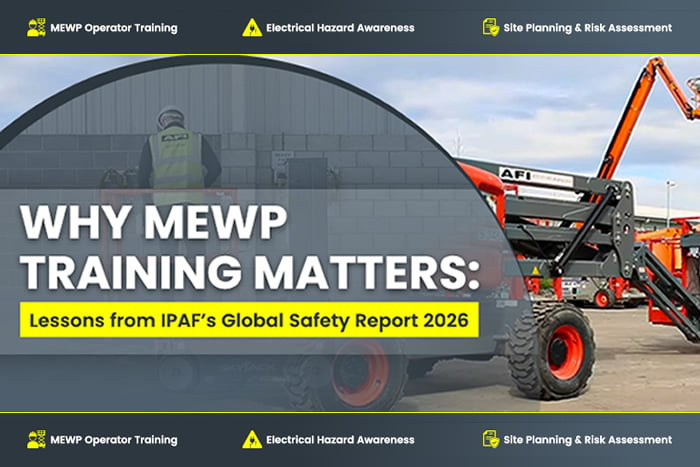
How does MEWP training help reduce workplace risk?
MEWP training gives operators the foundation to select, position, and use the relevant category of equipment safely, recognise hazards, and respond when conditions change. IPAF’s Global Safety Report 2026 shows that serious incidents still arise from familiar risks, including electrical hazards and falls from platforms. Reinforce training through machine-specific familiarisation, site planning, supervision, and clear controls at the point of work.
When an incident involves a mobile elevating work platform (MEWP), it is tempting to look for an unusual failure or an unfamiliar hazard. What IPAF’s Global Safety Report 2026 tells us about MEWP competence is more practical: serious outcomes continue to follow recognisable patterns, often where known risks are not controlled consistently. Training needs to carry through to the point of work, especially when conditions or plans change.
The report records 170 fatal and major incident reports in 2025, down from 201 in 2024, and 76 fatalities. Electrocution and electric shock, falls from platforms, and overturns were the top three causes in the fatal and major incident data. These are global reports submitted to IPAF, rather than a rate for all MEWP use, but they make a clear case for keeping the basics visible every time work is planned and carried out. Read the full IPAF Global Safety Report 2026: https://www.ipaf.org/en-gb/node/16198#key_findings
Training gives operators a foundation for safe decisions
Appropriate operator training develops the knowledge and practical skills needed for the MEWP category in use. It helps people understand the machine’s operating limits, carry out checks, position it correctly, and recognise when a task cannot proceed as planned. Those decisions matter when a site is busy, the ground or access route changes, or work takes longer than expected.
IPAF also makes an important distinction: competence extends beyond a formal course. Operators need relevant instruction, machine-specific familiarisation, practical experience, and an understanding of the task. A training card is an essential starting point, but it does not replace the need to assess the site, brief the team, and confirm the operator is familiar with the specific machine.
Electrical hazards show why planning and training work together
IPAF identifies electrical incidents as the leading cause in its 2025 fatal and major incident data. It recorded 28 reports of electrocution or electric shock, involving 20 fatalities. The report describes recurring problems with identifying electrical infrastructure, communicating the hazard, and maintaining safe clearance when a MEWP is in use.
Before work begins, the team needs a site-specific assessment of overhead lines and other electrical hazards, a suitable access method, and clear exclusion zones and emergency arrangements. People involved in the task should be trained and briefed on the applicable controls. During operation, the team must maintain the required clearances, use a trained spotter where the assessment calls for one, communicate effectively, and stop if conditions change. The site assessment must establish the required distances and controls using applicable guidance.
Competence has to be maintained on site
The report also discusses the gradual acceptance of shortcuts when previous unsafe acts have caused no obvious harm. A rushed setup or a familiar task can make controls feel optional. Refresher learning, supervision, near-miss reporting, and a culture where people can pause a task help teams challenge that drift.
For an employer, a useful review starts with a few practical questions: Is each operator trained for the MEWP category? Have they been familiarised with this machine? Does the supervisor understand the task and the rescue plan? Have site conditions and nearby people or services been considered? Are the controls still working as the task progresses? These checks make training useful where the decisions are made.
Choose training that fits the equipment and the role
AFI Training offers IPAF operator courses for relevant MEWP categories, alongside options for managers, more challenging operating environments, and harness use. The appropriate course depends on the machine and the person’s responsibilities. Our separate guide explains the distinction between IPAF operator training and machine-specific familiarisation in more detail.
The IPAF report's lesson is that training has the most value when you use it every day. Plan the task, choose the right MEWP, prepare the people involved, and give them the confidence to stop and reassess when the situation changes.
Next step: Explore AFI Training’s IPAF courses and discuss the right training for your team: https://training.afi-rentals.co.uk/courses/ipaf-training
FAQs
Does an IPAF operator card mean someone is competent on every MEWP?
No. The card confirms successful training for the categories shown, but competence also depends on relevant experience, the task, and familiarisation with the particular machine. The employer must make sure the operator is prepared for the work and its conditions.
What is the difference between IPAF training and MEWP familiarisation?
IPAF operator training covers the knowledge and skills for a MEWP category. Familiarisation addresses the controls, features, limits, and emergency procedures of the specific machine the trained operator will use.
Can training alone prevent incidents involving overhead power lines?
No. Training helps people recognise electrical hazards and follow safe procedures, but the work also needs a site-specific assessment, an appropriate access method, effective exclusion zones, communication, and supervision. The team must stop if safe clearance cannot be maintained.
Who else should receive MEWP safety training?
Managers and supervisors who plan or coordinate MEWP work need relevant knowledge as well as operators. AFI Training offers an IPAF MEWPs for Managers course, and the right programme should reflect each person’s role.