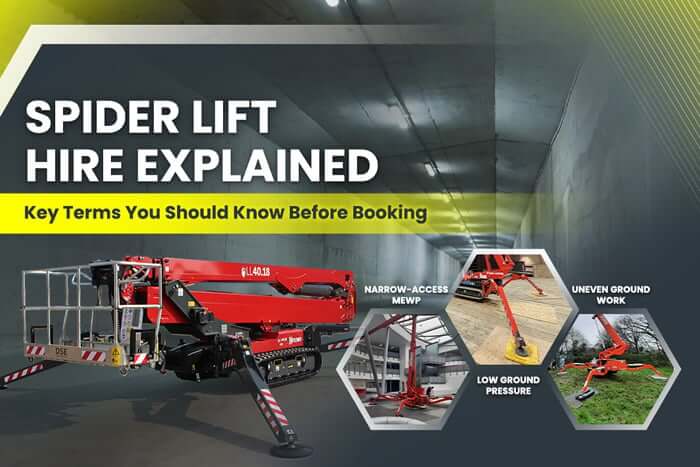
Hiring a spider lift should not feel complicated. But if you are looking at working height, outreach, ground pressure, SWL, IPAF, LOLER and operated hire for the first time, it can quickly become confusing.
This simple guide explains the spider lift terms you are most likely to come across when planning a job at height. Whether you are working on a construction site, maintaining a building, pruning trees, cleaning windows, inspecting a roof or accessing a restricted area, these terms will help you choose the right machine with more confidence.
What is a spider lift?
A spider lift is a type of mobile elevating work platform, also known as a MEWP. It uses crawler tracks instead of wheels and has stabilising legs, called outriggers, that spread out before the machine is elevated.
Spider lifts are popular because they are compact, stable and designed for awkward access. They are often used where a standard cherry picker, boom lift or scissor lift may not be suitable.
- restricted access areas
- narrow gates or doorways
- uneven ground
- soft or sensitive surfaces
- shopping centres and atriums
- tree surgery
- building maintenance
- heritage sites
- construction and infrastructure work
UK hire companies often describe these machines as spider lifts, tracked cherry pickers, tracked boom lifts or tracked access platforms.
Is a spider lift the same as a tracked cherry picker?
In most cases, yes. Customers often search for tracked cherry picker hire, while hire companies may describe the same type of machine as a spider lift, tracked boom lift or tracked access platform.
The key difference is not the name. The important thing is whether the machine has the right working height, outreach, weight, track width and ground pressure for your site.
When should I hire a spider lift?
A spider lift is a good choice when access is tight, the ground is uneven, or the work area cannot be reached safely with a standard machine.
Typical spider lift jobs include:
- roof and gutter work
- tree cutting and pruning
- window cleaning
- cladding and facade maintenance
- internal atrium work
- shopping centre maintenance
- heritage building access
- signage installation
- bridge and infrastructure inspection
- construction site access
What working height do I need?
Working height is one of the most important figures to check before hiring a spider lift.
It means the maximum height a person can reach while standing in the basket. As a simple guide, working height is usually around two metres higher than the platform height.
For example, if a machine has a platform height of 18 metres, the working height may be around 20 metres.
When booking spider lift hire, do not guess the height. Think about the actual point you need to reach, any obstacles in the way, and whether the machine can be positioned close enough to the work area.
What is the difference between working height and platform height?
This is one of the most common areas of confusion.
Platform height is the height of the basket floor. Working height is the approximate height a person can reach while standing in the basket.
For hiring, working height is usually the figure customers look at first. But if you are planning a technical job, platform height may also matter.
What does outreach mean on a spider lift?
Outreach is how far the basket can reach horizontally from the machine.
This matters when the spider lift cannot be placed directly underneath the work area. For example, you may need to reach over a roof, across landscaping, around a building feature or over a fragile surface.
A machine with more working height is not always the right answer. Sometimes the key figure is outreach.
What is Safe Working Load, or SWL?
Safe Working Load, often shown as SWL, is the maximum weight allowed in the basket.
This includes:
- the operator
- any additional person
- tools
- materials
- equipment
If a spider lift has a 230 kg or 300 kg basket capacity, that total must include everything in the basket. Never exceed the SWL, even for a short task.
Do I need IPAF training to use a spider lift?
A spider lift should only be operated by someone who is trained and competent. IPAF is one of the most recognised training routes for powered access operators in the UK.
If your team does not have a trained operator, operated spider lift hire may be the better option.
What is operated spider lift hire?
Operated hire means the spider lift is supplied with a trained operator.
This is often the best choice when:
- the site is complex
- access is restricted
- the ground conditions are difficult
- the job is short but specialist
- your team does not have a trained operator
- you want the machine positioned and operated by an experienced person
AFI spider lift hire gives customers flexibility depending on the job and internal capability, including options for self-drive or operator-supported hire where available.
What is self-drive spider lift hire?
Self-drive hire means the customer hires the machine and provides their own trained operator.
This can be a good option if your team already has the right IPAF training, understands the site, and is confident using powered access equipment safely.
Before choosing self-drive hire, make sure your operator is competent, the site is suitable, and the machine selected matches the working height, outreach and ground conditions required.
What are outriggers?
Outriggers are the stabilising legs that extend from the spider lift before it is elevated.
They help keep the machine stable during operation. The machine must be set up correctly before lifting, and each outrigger foot must be positioned safely.
No shortcuts should be taken with outriggers. They are a key part of safe spider lift operation.
What are spreader pads?
Spreader pads are placed under the outrigger feet.
They help spread the load over a wider area and reduce pressure on the ground. This is especially important on:
- soft ground
- grass
- paving
- finished floors
- suspended slabs
- sensitive surfaces
If the ground is weak or uneven, spreader pads can make a major difference to safe setup.
What does ground pressure mean?
Ground pressure is the force the machine applies to the surface below it.
This matters when working on soft ground, landscaped areas, indoor floors, car parks, basements or suspended slabs. A spider lift may be compact and lightweight compared with some other machines, but ground pressure still needs to be checked before work starts.
For sensitive sites, ask for machine weight, outrigger loadings and ground pressure information before booking.
Why does track width matter?
Track width tells you how wide the spider lift is when travelling through an access route.
This is important if the machine needs to pass through:
- a garden gate
- a narrow alley
- a doorway
- a corridor
- a courtyard entrance
- an internal access route
This is where spider lifts are often useful. Compact tracked access platforms are often chosen for narrow-access work where larger machines cannot get through.
What is basket rotation?
Basket rotation allows the platform to turn without moving the whole machine.
This helps the operator get into the right position more easily, especially when working on building facades, glazing, signage, cladding or maintenance jobs where small adjustments matter.
What is a jib boom?
A jib is the smaller boom section near the basket.
It gives extra flexibility and helps position the basket around obstacles. This can be useful when working over roofs, around corners, near walls or on jobs where the final basket position needs to be precise.
What is negative reach?
Negative reach means the boom can reach below the level where the machine is set up.
This can be useful for inspection or maintenance work below ground level, on embankments, bridges or lower sections of a structure.
Not every spider lift offers this, so it is worth asking if your job requires access below the machine setup level.
What are asymmetric outriggers?
Asymmetric outriggers allow the stabilising legs to be set at different positions.
This can help on restricted sites where there is not enough room to deploy all outriggers equally. For example, a machine may be positioned near a wall, kerb, building line or narrow pathway.
The setup still needs to be safe and within the machine operating limits.
What does LOLER mean?
LOLER stands for Lifting Operations and Lifting Equipment Regulations.
In simple terms, LOLER helps make sure lifting equipment is properly examined and safe to use. For spider lifts and other access platforms, regular thorough examinations are part of keeping the equipment compliant and safe for use.
What is familiarisation?
Familiarisation is machine-specific guidance before using a particular machine.
Even if an operator has IPAF training, they still need to understand the actual spider lift they are using. Controls, emergency lowering, stabiliser setup, operating limits and safety features can vary between machines.
Every machine is different, so familiarisation should not be skipped.
How much does spider lift hire cost in the UK?
The cost of spider lift hire depends on the machine size, hire duration, transport, operator requirement and site location.
A small tracked access platform will usually cost less than a large 30m or 40m spider lift. Operated hire may also be priced differently from self-drive hire because it includes a trained operator.
For accurate pricing, it is best to share the job details, location, working height, outreach, access restrictions and whether you need operated or self-drive hire.
How do I choose the right spider lift?
The easiest way is to answer these questions before booking:
- What height do you need to reach?
- How far away is the machine from the work area?
- Is there enough space to get the machine into position?
- Is the ground flat, soft, uneven or sensitive?
- Do you need indoor or outdoor use?
- How many people and tools will be in the basket?
- Do you have a trained operator?
- Do you need operated hire?
Once you know these details, the hire team can recommend the most suitable spider lift for the job.
Need help choosing a spider lift?
If you are not sure which spider lift is right for your site, AFI Rentals can help. From compact tracked access platforms for restricted areas to larger spider lifts for demanding height and outreach requirements, the team can advise on the right option for your project.
Explore AFI Rentals spider lift hire range or speak to the team for help choosing the best machine for your job.
FAQs
What is a spider lift used for?
A spider lift is used for safe access to height where standard machines may not be suitable. Common uses include construction, maintenance, tree surgery, window cleaning, signage, roof work, shopping centres and heritage buildings.
Is a spider lift the same as a cherry picker?
A spider lift is a type of cherry picker, but it runs on tracks and uses outriggers for stability. It is also known as a tracked cherry picker, tracked boom lift or tracked access platform.
Can a spider lift go through a doorway?
Some compact spider lifts are designed for narrow access and may fit through doorways or tight entrances. Always check the machine track width and transport dimensions before booking.
Can spider lifts be used indoors?
Yes, some spider lifts can be used indoors, depending on the machine type, power source, floor loading, ventilation, access route and ground conditions.
Do I need IPAF to operate a spider lift?
A spider lift should only be used by someone who is trained and competent. IPAF training is widely recognised in the UK for MEWP operators.
What is better, operated hire or self-drive hire?
Operated hire is usually better for complex jobs or when you do not have a trained operator. Self-drive hire may suit companies with trained staff and straightforward site conditions.
What is the difference between working height and outreach?
Working height is how high the operator can work. Outreach is how far the basket can reach sideways from the machine.
What does SWL mean?
SWL means Safe Working Load. It is the maximum weight allowed in the basket, including people, tools and materials.
Do spider lifts need LOLER inspections?
Yes. Spider lifts are lifting equipment and must be properly examined in line with LOLER requirements.
What information should I provide before hiring a spider lift?
Share the site location, working height, outreach, ground conditions, access width, indoor or outdoor use, number of operators, tools and materials weight, and whether you need operated hire.