
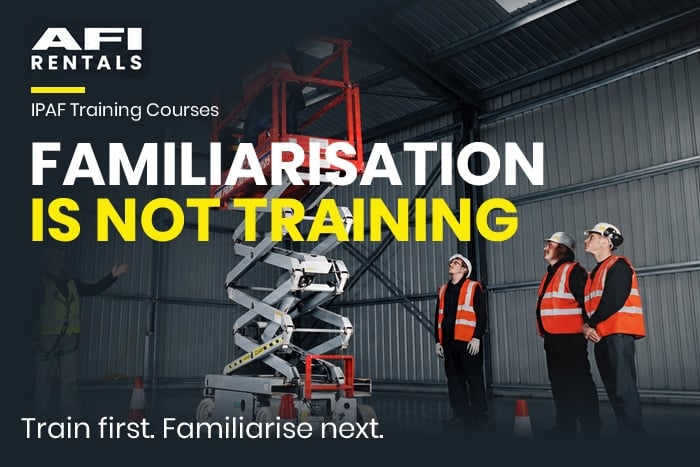
When it comes to operating a Mobile Elevating Work Platform (MEWP), one misunderstanding can create a serious gap in safe working practice: assuming that familiarisation is the same as operator training.
It isn’t. Training and familiarisation have different purposes, and operators may need both before using a particular machine.
Whether you are operating a scissor lift, boom lift, cherry picker or another type of powered access equipment, appropriate IPAF training should come first. Familiarisation then helps a trained operator understand the specific make, model, controls and safety features of the machine they are about to use.
TRAIN FIRST. FAMILIARISE NEXT. OPERATE SAFELY.
What is IPAF training?
IPAF Operator training is designed to give operators the knowledge and practical skills required to safely and effectively operate the relevant category of MEWP. The official IPAF MEWP Operator Training Course includes theory and practical training followed by assessment.
On successful completion, operators receive a Powered Access Licence (PAL Card) through ePAL for the categories in which they have been trained. AFI offers a comprehensive range of IPAF training courses across the UK, including 3A, 3B, 1B, combined 3A and 3B, eLearning, PAL+ and MEWPs for Managers.
For many operators, two of the most commonly required categories are:
- IPAF 3A – Mobile Vertical: typically used for mobile vertical MEWPs such as scissor lifts and mobile vertical personnel platforms. View AFI IPAF 3A training.
- IPAF 3B – Mobile Boom: used for self-propelled boom-type MEWPs, commonly described as boom lifts or cherry pickers. View AFI IPAF 3B training.
- IPAF 1B – Static Boom: used for truck mounts, spider lifts, trailers. View AFI IPAF 1B training
Operators who need both categories can complete a combined IPAF 3A and 3B Operator Course with AFI Training.
What is MEWP familiarisation?
MEWP familiarisation is machine-specific. It comes after appropriate operator training and focuses on the particular MEWP an operator is going to use.
IPAF’s F1 Familiarisation of Mobile Elevating Work Platforms guidance states that familiarisation is required before operating a MEWP that is significantly different in weight, height, length or complexity from the MEWP on which training took place.
That distinction matters because two machines in the same category can have different controls, operating characteristics, emergency systems, alarms, secondary guarding and manufacturer-specific limitations.
The common mistake: "I’ve been shown the controls, so I’m trained"
This is where training and familiarisation are often confused. An operator may arrive on site and be shown how to start the machine, which joystick raises the platform, how to drive it and where the emergency lowering controls are located.
That can form part of familiarisation. It does not, by itself, replace structured operator training for the relevant MEWP category.
IPAF’s familiarisation guidance makes the sequence clear: machine-specific familiarisation should follow basic training. If an operator needs formal category training, AFI’s IPAF course range provides operator options for mobile vertical, mobile boom and other powered access categories.
What should MEWP familiarisation cover?
The exact content depends on the machine, but familiarisation should help the operator understand how the specific MEWP is configured and how its safety systems work.
- Manufacturer’s instructions and warnings in the operator’s manual
- The location and use of platform, ground and auxiliary controls
- Visual inspections and pre-use checks
- Safety features, functions and devices
- Operating characteristics and limitations
- Emergency lowering procedures
- How secondary guarding systems are checked or reset, where fitted
- Any additional item specified by the MEWP manufacturer
The aim is simple: a trained operator should understand the actual machine they have been asked to operate rather than assuming every scissor lift or boom lift works in exactly the same way.
Do I still need familiarisation if I already have an IPAF Card?
Potentially, yes. A valid PAL Card demonstrates that the operator has successfully completed training and assessment for the categories shown on the card. It does not mean the operator is automatically familiar with every manufacturer, model or control system within those categories.
For example, an operator may regularly use one type of 3A scissor lift and then arrive on a project where a different model has unfamiliar controls, safety devices or emergency procedures. Appropriate familiarisation helps bridge that machine-specific knowledge gap before work starts.
Why does the difference matter?
MEWPs are used across construction, facilities management, M&E installation, steel erection, warehousing, utilities, telecommunications, aviation, cleaning and industrial maintenance. In these environments, operators may encounter different makes and models from one site to the next.
Treating familiarisation as a replacement for training risks leaving an operator without the broader knowledge and practical skills required for the MEWP category. Treating training as a substitute for machine-specific familiarisation can create a different problem: the operator may be trained, but unfamiliar with the exact controls and features of the machine in front of them.
The safer approach is to recognise that the two processes complement each other.
Which IPAF course do you need?
The right course depends on the type of powered access equipment you need to operate and your role on site.
IPAF 3A – Scissor lift training
For mobile vertical platforms such as scissor lifts, the relevant operator category is generally IPAF 3A. AFI’s IPAF Operator – Mobile Vertical 3A course combines theory and practical training and covers safe preparation, manoeuvring, driving and positioning of mobile vertical MEWPs.
IPAF 3B – Boom lift and cherry picker training
For self-propelled boom-type MEWPs, the relevant category is generally IPAF 3B. AFI’s IPAF Operator – Mobile Boom 3B course is designed for operators who need to safely use self-propelled booms.
Combined IPAF 3A and 3B training
Many operators need to work with both machine types. AFI’s IPAF 3A and 3B Operator Training Course covers both mobile vertical and mobile boom categories in one combined route.
Can IPAF training be completed online?
The theory element of operator training can be completed through AFI’s IPAF eLearning option. After successfully completing the online theory, candidates still need the required practical training and testing before being issued their PAL Card.
This can be useful for employers looking to reduce time away from site while still ensuring operators complete the practical element of their qualification.
What about supervisors and managers?
Safe MEWP use is not only an operator responsibility. People planning, supervising or managing MEWP operations also need to understand equipment selection, risk controls and the importance of operator familiarisation.
AFI’s IPAF MEWPs for Managers course is designed for supervisors and managers who prepare for and coordinate the use of MEWPs within their control.
What if operators work in higher-risk environments?
For trained IPAF operators working in higher-risk or more challenging environments, AFI also offers IPAF PAL+ training. PAL+ is additional category-specific training for operators who already hold a valid PAL Card and may work in conditions such as confined overhead spaces, steelwork or challenging terrain.
Training first. Familiarisation second.
The difference is straightforward but important.
- Training develops the knowledge and skills needed to safely operate the relevant category of MEWP.
- Familiarisation introduces an appropriately trained operator to the specific machine they are about to use.
One does not replace the other. When operators are properly trained and appropriately familiarised, they are better prepared to use powered access equipment safely and as intended.
FAQs
Is MEWP familiarisation the same as IPAF training?
No. Operator training develops competency for the relevant MEWP category, while familiarisation focuses on the specific make, model, controls and features of the machine being used.
Do I need familiarisation if I already have an IPAF Card?
You may do. If the MEWP is unfamiliar or significantly different from the machine on which training took place, machine-specific familiarisation may be required before operation.
What is IPAF 3A and 3B training?
IPAF 3A covers mobile vertical MEWPs such as scissor lifts. IPAF 3B covers mobile boom MEWPs such as self-propelled boom lifts. Operators who use both can take a combined 3A and 3B course.
How long is an IPAF PAL Card valid?
IPAF and AFI course information state that the PAL Card is generally valid for five years, after which operators need renewal or reassessment as appropriate.
Can I complete IPAF training online?
The theory element can be completed through eLearning, but operator certification still requires practical training and testing.