
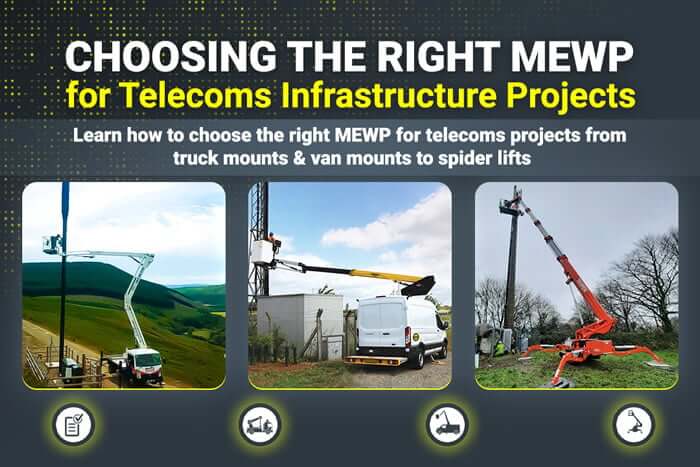
Telecoms engineers work in a wide range of challenging environments, from roadside mobile phone masts and rooftop installations to remote communications sites and densely populated urban locations. No two projects are exactly the same, which means choosing the right Mobile Elevating Work Platform (MEWP) is an important part of planning safe, efficient work at height.
The wrong machine can create unnecessary delays, increase costs and make access more difficult. The right machine helps engineers reach the work area safely, complete tasks more efficiently and minimise disruption to surrounding businesses, road users and the public.
At AFI-Rentals, our specialist telecoms team supports projects across the UK with truck-mounted platforms, van-mounted platforms, tracked spider lifts, site surveys, traffic management and project planning. Selecting the right access solution starts long before the machine arrives on site. It begins with understanding the environment, the work to be carried out and any restrictions that could affect the project. AFI supports telecoms contractors with specialist planning, site surveys, RAMS, permit management and a modern fleet of access equipment designed for a wide variety of telecoms applications.
What is the best MEWP for telecoms infrastructure work?
The best MEWP depends on the location, working height, ground conditions and type of telecoms installation. Truck-mounted platforms are ideal for roadside and high-level work; van-mounted platforms provide fast access for maintenance in urban environments; and tracked spider lifts are well suited to restricted or uneven ground. A site survey helps identify the safest and most efficient access solution before work begins.
Why Choosing the Right MEWP Matters
Telecoms infrastructure projects often involve more than simply reaching a working height. Engineers may need to transport equipment, work alongside live roads, access confined locations or operate around existing buildings and utilities. Every project presents different challenges, including:
- Working height
- Ground conditions
- Site access restrictions
- Traffic management requirements
- Public safety
- Permit requirements
- Time available to complete the work.
Selecting a suitable MEWP at the planning stage helps avoid costly delays once work begins. It also reduces the likelihood of changing equipment during the project, which can affect programme schedules and increase hire costs. This is why many telecoms contractors carry out a detailed site survey before confirming which machine will be used.
What Should You Consider Before Choosing a MEWP?
Rather than choosing equipment based purely on platform height, project managers should consider several factors together.
Working Height and Outreach
The first consideration is how high engineers need to work and how far they need to reach horizontally. For example, a telecoms mast located behind fencing or roadside barriers may require greater outreach than a platform positioned directly beneath the work area. Similarly, rooftop installations may require a machine capable of reaching over parapets or neighbouring structures without compromising safe working distances. Choosing equipment with sufficient outreach can often eliminate the need for additional repositioning during the project.
Ground Conditions
Ground conditions have a significant influence on machine selection. Some telecoms sites are located on:
- Grass verges
- Soft ground
- Uneven terrain
- Gravel access roads
- Rural compounds.
Others are positioned within town centres or commercial developments where hard standing is readily available. Truck-mounted platforms generally perform well where there is suitable road access and adequate space for stabilisers. Tracked spider lifts can provide an effective alternative where ground conditions are more challenging or access routes are restricted.
Understanding the ground conditions before equipment arrives helps ensure the safest machine is selected for the location.
When Should You Use a Truck-Mounted Platform?
Truck-mounted platforms are commonly used on telecoms infrastructure projects because they combine excellent working height with the ability to travel efficiently between multiple locations. They are particularly well suited to:
- Mobile phone mast maintenance
- High-level antenna installations
- Roadside infrastructure
- Urban telecoms projects
- Planned maintenance programmes
- Multi-site contracts.
Modern truck-mounted platforms can provide working heights of up to 75 metres, allowing engineers to access a wide variety of telecommunications infrastructure safely and efficiently. AFI's fleet includes modern truck-mounted platforms with working heights up to 75 metres, supported by experienced operators, site surveys and project planning where required.
Truck-mounted platforms can also reduce mobilisation time between sites, making them a practical solution for maintenance teams completing multiple inspections or repairs in a single day.
When Are Van-Mounted Platforms the Better Option?
Van-mounts provide a compact, versatile solution for lower-level telecoms work where speed and accessibility are priorities. Because the access platform is integrated onto a commercial van, engineers can travel easily through urban areas before setting up quickly at the site. Typical applications include:
- Small cell maintenance
- CCTV installation
- Fibre network maintenance
- Street furniture
- Utility poles
- Low-level communications equipment.
Their compact footprint makes them particularly useful where parking space is limited, or work is taking place within busy town and city centres. For reactive maintenance work, van-mounted platforms often provide the fastest and most efficient access solution.
When Should You Choose a Tracked Spider Lift?
Not every telecoms site is easily accessible by road. Some installations are located behind buildings, within compounds, across landscaped areas or on ground that would be unsuitable for larger vehicles.
In these situations, a tracked spider lift can provide a practical alternative. Tracked spider lifts are designed to travel across more challenging terrain while spreading their weight more evenly than many conventional machines. Their compact dimensions also allow them to pass through narrow access points before setting up close to the work area.
Typical telecoms applications include:
- Rural communications sites
- Remote transmitter locations
- Uneven ground
- Sites with restricted vehicle access
- Areas where ground protection is required.
Because these machines can often be positioned much closer to the work area, they can improve efficiency while reducing the amount of manual handling required for equipment and tools. AFI operates one of the UK's largest fleets of tracked spider lifts, supporting telecoms contractors working in locations where conventional access equipment may not be suitable.
Choosing the Right MEWP for Rooftop Telecoms Work
Many telecommunications projects involve equipment installed on commercial buildings, apartment blocks, hospitals and public buildings. Although rooftop work may appear straightforward, access can often be the biggest challenge.
Project managers should consider:
- Available set-up space
- Building height
- Horizontal outreach
- Nearby structures
- Pedestrian areas
- Traffic management requirements
- Emergency access.
A truck-mounted platform often provides the safest and most efficient solution where there is sufficient access around the building. However, every site is different, which is why a pre-start survey is so valuable. Understanding the site before work begins helps identify the safest machine, the best set-up location and any additional measures required to complete the work safely.
Why Site Surveys Make All the Difference
Choosing the correct MEWP should never be based solely on working height. A professional site survey considers the entire project, helping identify potential issues before equipment is delivered. During a survey, factors such as access routes, ground conditions, overhead obstructions, nearby utilities, working height, outreach requirements and public safety can all be assessed. This allows project teams to:
- Select the most suitable machine
- Reduce unnecessary costs
- Minimise delays
- Improve site safety
- Plan traffic management
- Confirm permit requirements.
AFI provides both desktop surveys and on-site surveys, together with pre-start meetings where required. This planning helps ensure projects begin with the right equipment and the right support from day one.
Don't Overlook Traffic Management and Permits
Access equipment is only one part of a successful telecoms project. Many roadside and urban installations require temporary traffic management, pedestrian management or permits before work can begin. Without these arrangements in place, even the right machine may be unable to operate. Planning ahead helps avoid unnecessary disruption and keeps projects moving to schedule. AFI can support telecoms contractors with:
- Site surveys
- RAMS
- Traffic management
- Pedestrian management
- Permit coordination
- Project planning.
We are also accredited to work on sites operated by Cellnex, Ericsson and MBNL and can arrange permits for operatives where required, helping simplify project planning for customers working across multiple telecoms networks.
Choosing the Right Access Hire Partner
The most successful telecoms projects begin with good planning rather than simply selecting the nearest available machine. Working with an experienced powered access provider means you can receive advice before work starts, helping ensure the equipment matches the site, the programme and the task. AFI-Rentals supports telecoms infrastructure projects across the UK with:
- Modern truck-mounted platforms with working heights up to 75 metres
- Compact van-mounted platforms
- Tracked spider lifts
- Nationwide coverage
- Site surveys
- Traffic management
- RAMS
- Dedicated project support
- Experienced operators where required.
Whether you're maintaining a single rooftop installation or managing a nationwide infrastructure programme, choosing the right MEWP from the outset can improve safety, reduce downtime and help keep projects running efficiently.
Book a Free Telecoms Site Survey
Not sure which machine is right for your project? AFI's telecoms specialists can assess your site and recommend the most appropriate access solution before work begins, helping you save time, reduce costs and improve safety.
FAQs
What is the best MEWP for telecoms infrastructure work?
There isn't a single solution for every project. The most suitable MEWP depends on working height, outreach, ground conditions, access restrictions and the type of telecoms installation being maintained.
When should I use a truck-mounted platform?
Truck-mounted platforms are ideal for higher-level telecoms work, roadside projects, multi-site maintenance programmes and locations where good road access is available.
When is a van-mounted platform a better choice?
Van-mounted platforms are well suited to lower-level maintenance work, urban environments and projects requiring quick mobilisation between multiple locations.
Why are tracked spider lifts used on telecoms projects?
Tracked spider lifts provide safe access where ground conditions are uneven, access is restricted or conventional vehicles cannot reach the work area.
Why is a site survey important?
A site survey helps identify the safest and most efficient access solution by assessing working height, ground conditions, access routes, traffic management requirements and any site-specific constraints before work begins.